
With the stockout rate for BPC-157 reaching 44.8% in August 2026, many Australian laboratories find themselves stalled by a fractured global supply chain. Securing rare molecules often feels like a gamble against impure materials and opaque logistics. This is why custom research product sourcing has become a critical competency for modern researchers. It transforms a chaotic search for reagents into a disciplined, technical process that ensures your project remains on schedule.
You understand that laboratory integrity depends on the precision of your materials. It's frustrating when procurement hurdles or unverified compounds compromise your data. This guide outlines how to master the complexities of technical procurement to secure rare research compounds with precision and integrity. We'll examine the essential steps to streamline your procurement timeline, verify purity via HPLC reports, and manage the specific logistical requirements for the Australian market. By the end of this guide, you'll be equipped to organise a reliable supply of rare reagents without the typical technical friction.
Key Takeaways
- Identify why standard laboratory catalogues often fail to meet the requirements of advanced study and how to mitigate the risks of unverified materials.
- Learn to implement a systematic bridge to rare compounds through custom research product sourcing, ensuring a steady supply of niche reagents.
- Compare lead times and purity guarantees between specialist procurement and standard off-the-shelf solutions for high-precision experimentation.
- Master the drafting of technical sourcing briefs by defining precise molecular specifications, CAS numbers, and mandatory salt forms.
- Streamline your laboratory procurement timeline by leveraging methodical verification processes, including batch-specific HPLC chromatograms and mass spectrometry data.
Navigating the Challenges of Specialised Research Compound Procurement
Standard laboratory catalogues provide a baseline for common reagents, yet they frequently fail the requirements of advanced bioscience. When a project requires a specific molecular sequence or a rare reagent, standard inventories are often exhausted or non-existent. Relying on off-the-shelf solutions in high-precision experimentation introduces significant risks, including batch-to-batch variability and unverified purity levels. For Australian researchers, these limitations are compounded by geographical distance and complex import logistics. A localised procurement partner acts as a necessary buffer, managing the technical and logistical hurdles that otherwise stall progress.
Effective Custom peptide synthesis and procurement require more than just a simple purchase order. They demand a methodical bridge between the researcher's molecular blueprint and the global synthesis laboratory. This is where custom research product sourcing becomes essential. It provides a structured pathway to secure compounds that are otherwise inaccessible through traditional retail channels, ensuring that specific molecular requirements are met with clinical precision.
The Scarcity Gap in Modern Bioscience
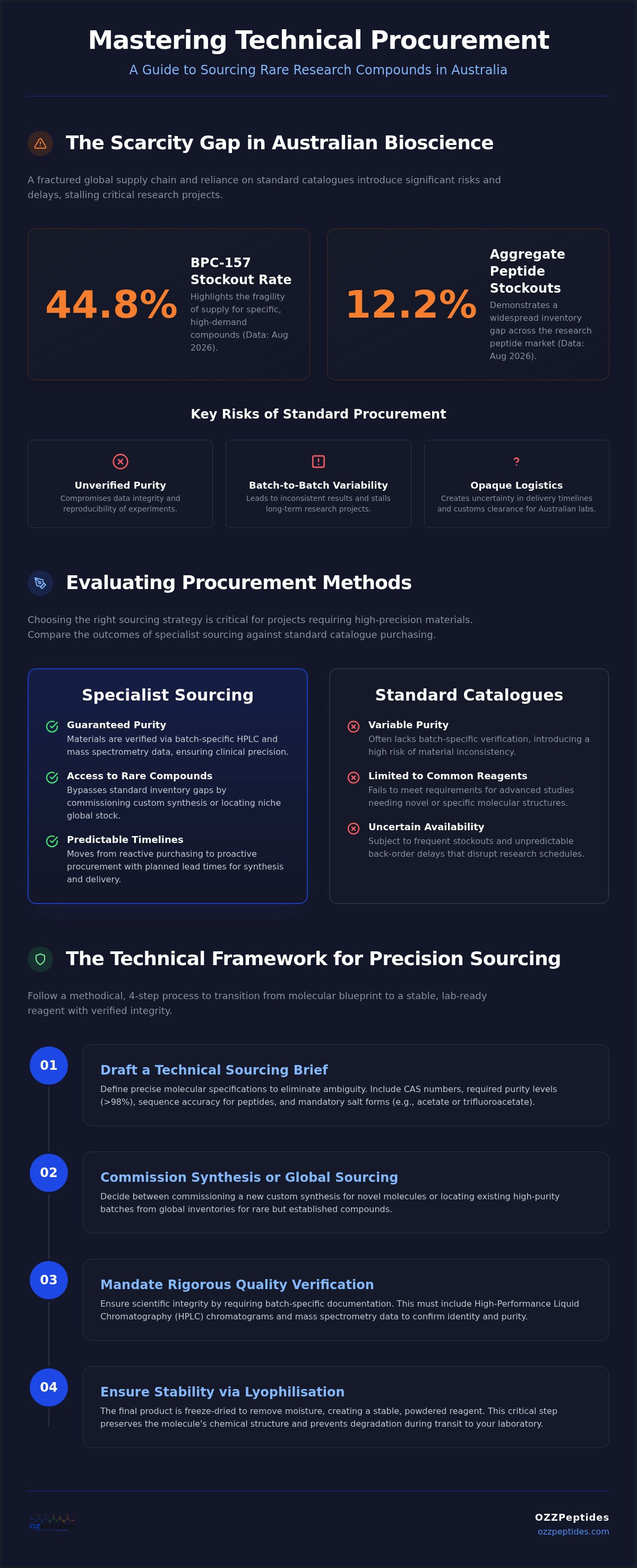
Emerging research hypotheses often outpace the production cycles of major suppliers. In August 2026, the aggregate stockout rate for research peptides reached 12.2 per cent, with specific compounds like BPC-157 experiencing a 44.8 per cent stockout rate. These constraints highlight the fragility of standard supply chains. Custom sourcing supports novel scientific work by bypassing inventory gaps and commissioning the exact material required. While lead times for custom synthesis require careful planning, they provide a predictable timeline compared to the uncertainty of back-ordered stock. It's a strategic shift from reactive purchasing to proactive procurement.
Regulatory and Safety Compliance for Lab Use
Professional standards in chemical procurement prioritise security and institutional trust. Every compound must adhere to strict "laboratory research use only" protocols to ensure scientific integrity. This discipline prevents the diversion of materials for non-scientific applications. Australian researchers require a localised partner who understands domestic regulatory frameworks and maintains meticulous documentation. Ensuring that compounds are handled with professional rigour is not just a safety requirement; it's a fundamental component of reproducible research. By focusing on HPLC-verified purity and secure logistics, the custom research product sourcing process remains grounded in traditional professional ethics.
The Technical Framework of Custom Product Sourcing and Synthesis
The procurement of specialised reagents relies on a methodical transition from theoretical molecular blueprints to tangible, stable reagents. This systematic bridge, known as custom research product sourcing, ensures that rare compounds meet the exact requirements of a study. Precision starts at the molecular level. Technical markers such as exact molecular weight, sequence accuracy for peptides, and specific salt content (such as trifluoroacetate or acetate forms) must be defined before synthesis begins. These variables dictate the compound's behaviour in aqueous solutions and its overall stability.
Stability during transit is a primary concern for Australian laboratories. Lyophilisation, or freeze-drying, removes moisture from the synthesised product while preserving its chemical structure. This process results in a stable, powdered reagent that resists degradation during the logistics phase. It's a critical step for maintaining the integrity of sensitive molecules before they reach the laboratory bench. By ensuring the compound remains in a solid state, researchers can better manage storage and reconstitution protocols upon arrival.
Custom Synthesis vs. Global Sourcing
Researchers must decide between commissioning a new synthesis or locating existing high-purity batches within global inventories. Synthesis is often necessary for novel sequences that haven't been produced before. Global sourcing is more efficient for established but rare compounds that are currently out of stock in standard catalogues. Evaluating the cost-to-purity ratio is essential here. Complex molecules with multiple disulfide bridges or unusual side-chain modifications increase synthesis costs and lead times. Understanding these Best Practices for Drafting a Technical Sourcing Brief allows researchers to communicate these requirements clearly to procurement partners. It's about finding the most efficient path to a verified result.
Verification Protocols: HPLC and MS Analysis
Verification is the final, non-negotiable stage of the procurement framework. High-Performance Liquid Chromatography (HPLC) remains the gold standard for purity verification within the scientific community in 2026. It identifies the percentage of the target molecule relative to impurities. Mass Spectrometry (MS) complements this by confirming the molecular mass, ensuring the sequence produced matches the sequence requested. These reports provide the objective evidence required for clinical-grade research. If your project requires this level of technical assurance, you may explore our specialist procurement services to secure verified reagents. Every batch should be accompanied by these analytical reports to maintain the discipline of your laboratory standards.
Evaluating Specialist Sourcing vs. Standard Laboratory Catalogues
The selection between standard inventory and bespoke synthesis is a strategic decision that impacts both the budget and the technical integrity of a study. Standard laboratory catalogues serve as a convenient resource for common reagents, offering predictable pricing and immediate dispatch. However, these catalogues are built for the median user. They lack the flexibility required for niche research where specific molecular variants or salt forms are mandatory. When a project moves beyond the baseline, custom research product sourcing becomes the necessary alternative to ensure experimental precision.
Catalogue Procurement: The Pros and Cons
Catalogues are efficient for high-volume, established compounds where standard specifications suffice. Their primary advantage is speed. If a reagent is in stock, it can often be delivered within days. The limitations arise when a compound is "out of stock" or when the available purity levels don't meet the requirements of a sensitive assay. Standard suppliers rarely offer customisation of purity or molecular modifications. This rigidity forces researchers to adapt their experiments to the available materials, rather than using materials tailored to the hypothesis. Traditional supply chains are also prone to systemic stockouts, leaving projects stalled for months without a viable alternative.
The Specialist Sourcing Advantage
A specialised approach provides access to a global synthesis network through a single Australian point of contact. This model offers several distinct advantages for high-precision experimentation:
- Tailored Purity Levels: Specialists can secure compounds with purity exceeding 98 per cent, which is often unavailable in standard retail inventories.
- Molecular Flexibility: Researchers can specify exact salt forms, side-chain modifications, or specific sequences without being restricted by a fixed catalogue.
- Professional Lifecycle Oversight: From the initial technical brief to final delivery, the procurement process is managed with clinical discipline.
Risk mitigation is a core component of this service. Using unverified third-party suppliers from global marketplaces introduces the danger of receiving impure, degraded, or entirely incorrect materials. For those Navigating the Challenges of Specialised Research Compound Procurement, maintaining a secure chain of custody is non-negotiable. This is particularly vital in the Australian context. Our geographical isolation and harsh climate require meticulous "last mile" logistics to protect temperature-sensitive reagents. A specialist partner manages these environmental variables, ensuring that the integrity of the compound is preserved from the laboratory of origin to the Australian research facility.
Best Practices for Drafting a Technical Sourcing Brief
Successful custom research product sourcing begins with a high-fidelity technical brief. Ambiguity in the initial request often leads to logistical delays, material rejection, or compromised experimental results. A well-constructed brief acts as a technical contract between the researcher and the facilitator, ensuring that every molecular requirement is understood and met before synthesis or procurement commences. Researchers should follow a methodical five-step process to define their requirements.
- Define Molecular Specifications: Use CAS numbers as the primary identifier to avoid nomenclature errors. Provide the exact amino acid sequence or chemical structure required.
- Establish Purity and Salt Forms: State a minimum purity threshold (e.g., 98 per cent). Specify the required salt form, such as acetate or trifluoroacetate, as this affects solubility and biological activity.
- Specify Quantity and Physical State: Define the total mass required and the preferred physical form. Lyophilised powder is generally the standard for stability during transit.
- Mandate Analytical Documentation: Explicitly request a batch-specific Certificate of Analysis (CoA), HPLC chromatograms, and Mass Spectrometry (MS) data.
- Outline Logistical Requirements: Specify if the material requires cold-chain management or specific desiccant packaging for the Australian climate.
Precision in Technical Documentation
CAS numbers are the non-negotiable anchors of chemical procurement. Relying on common names is risky, as synonyms can vary across different global regions. When defining "Research Grade" for your study, you must quantify what this means in terms of allowable impurities. Setting clear benchmarks for by-products and residual solvents ensures the synthesised compound won't interfere with sensitive assays. If your study requires specific trifluoroacetate (TFA) removal, this must be highlighted in the brief to avoid the need for post-synthesis purification, which can extend the procurement timeline.
Logistics and Handling Requirements
Organising secure transit for fragile laboratory compounds requires an understanding of Australia's unique environmental challenges. High ambient temperatures during transit can degrade sensitive molecules if they aren't properly protected. Effective cold-chain management and the use of high-grade desiccants are essential for maintaining the stability of lyophilised reagents. Professional delivery to the facility should be both discreet and efficient, ensuring the chain of custody remains intact. To begin your procurement process with a precise technical framework, you can submit your technical brief for custom sourcing to our specialist team. This methodical approach ensures that the "last mile" of delivery is as disciplined as the synthesis itself.
Streamlining Your Laboratory Procurement with OZZPeptides
OZZPeptides functions as a specialised facilitator for the Australian scientific community. We bridge the gap between complex molecular requirements and global synthesis capabilities. Our approach to custom research product sourcing is built on clinical precision and institutional trust. We understand the rigorous requirements of laboratory research and prioritise reliability over emotional persuasion. By acting as a dependable partner, we ensure that rare research compounds are secured with the same discipline applied to our standard inventory. It's a methodical process designed to respect the researcher's time and experimental goals.
Our verification process involves multiple stages of technical assessment. We don't just locate materials; we verify their integrity. Every sourced compound undergoes rigorous testing to confirm it meets the specific molecular weight and sequence accuracy defined in your technical brief. This focus on objective evidence ensures that your laboratory data remains reproducible and valid. We maintain high professional ethics by adhering strictly to "laboratory research use only" protocols, preventing the diversion of materials for non-scientific applications. This commitment to safety and professional standards appeals to a detail-oriented audience that values accuracy above all else.
Your Partner in Advanced Research Logistics
Localised partnership provides distinct advantages in global procurement. OZZPeptides simplifies the path from identifying a rare reagent to its final laboratory delivery. We focus on technical transparency, providing batch-specific HPLC and MS reports for every custom order. This level of oversight mitigates the risks associated with unverified third-party suppliers. Custom sourcing acts as a seamless extension of our core research peptide inventory, allowing researchers to scale their procurement as their study evolves. We manage the logistical friction of international imports, ensuring that your project remains on schedule despite global supply chain volatility.
Initiating the Sourcing Process
The transition from identification to action is designed to be frictionless. Researchers initiate the process by providing a detailed technical request, including CAS numbers and purity thresholds. Our team then evaluates global synthesis networks to identify the most efficient procurement pathway. During the verification phase, we coordinate the necessary analytical testing to confirm the material's specifications. You can contact our specialist team to discuss your custom sourcing requirements. We provide clear communication regarding lead times and technical feasibility, allowing you to plan your project with confidence. Our commitment to clinical standards ensures that every compound delivered to your facility meets the highest benchmarks of quality and integrity.
Advancing Your Research with Precision Procurement
Precise procurement is the foundation of reproducible science. This guide has outlined the transition from standard catalogue limitations to a methodical framework for bespoke synthesis. By prioritising HPLC-verified purity reports and secure, clinical-grade procurement protocols, you eliminate the risks associated with unverified materials. Maintaining a disciplined chain of custody is essential for protecting the integrity of your experimental data.
OZZPeptides operates as a specialised Australian research supplier, providing a streamlined bridge to global synthesis networks while managing the unique logistical hurdles of our local climate. Our approach to custom research product sourcing ensures that your laboratory remains equipped with rare reagents that meet exact molecular specifications. This technical transparency allows you to focus on your hypothesis rather than procurement friction. Enquire about custom research product sourcing today to secure the high-purity compounds your study requires. We're ready to support your next scientific breakthrough with clinical accuracy and professional integrity.
Frequently Asked Questions
What is custom research product sourcing?
Custom research product sourcing is a specialised procurement bridge that secures rare reagents and laboratory compounds not found in standard inventories. This process involves leveraging global synthesis networks to provide specific molecular sequences or rare reagents tailored to a researcher's exact requirements. It ensures that advanced studies aren't restricted by the limitations of standard laboratory catalogues or systemic stockouts.
How long does it typically take to source a rare research compound in Australia?
Lead times for custom procurement typically range from four to eight weeks depending on molecular complexity and synthesis requirements in 2026. While locating existing high-purity batches may be faster, commissioning a new synthesis requires meticulous production and verification phases. We manage the logistical hurdles of Australian imports to ensure the most efficient procurement timeline possible for your facility.
Can I request a specific purity level for a custom-sourced peptide?
Researchers can specify exact purity thresholds, with levels of 98 per cent or higher commonly requested for sensitive experimental designs. This level of customisation allows for the control of side-chain modifications and specific salt forms. By defining these parameters in the technical brief, you ensure the reagent behaves predictably within your study's specific aqueous solutions and biological assays.
Are custom-sourced products provided with HPLC and MS reports?
Every custom-sourced compound is provided with batch-specific High-Performance Liquid Chromatography (HPLC) and Mass Spectrometry (MS) reports. These documents serve as the gold standard for purity verification and sequence validation. Providing this technical transparency is a core component of our clinical standards, ensuring that researchers have objective evidence of the material's integrity before starting their work.
What information is required to start a custom sourcing request?
To initiate a request, you must provide the precise molecular sequence or chemical structure along with the relevant CAS number. Additional requirements include the minimum purity threshold, preferred salt form, and the total mass required. Specifying the desired physical state, such as a lyophilised powder, helps us organise the most stable form for transit and laboratory storage.
Is custom sourcing available for compounds not listed on the OZZPeptides website?
Yes, the custom research product sourcing service is specifically designed to secure reagents and laboratory compounds that are absent from our standard catalogue. We act as an efficient facilitator for rare items, utilising a global network to locate or synthesise niche molecules. This service allows Australian researchers to bypass the stockout hurdles often found in traditional pharmaceutical supply chains.
How does OZZPeptides ensure the stability of sourced compounds during shipping?
Stability is maintained through the use of lyophilisation, which preserves the chemical structure by removing moisture from the synthesised product. For transit within the Australian climate, we employ specialised packaging including high-grade desiccants and cold-chain management where required. These protocols ensure that temperature-sensitive laboratory research products remain stable from the point of origin to your research facility.
Are custom-sourced items eligible for laboratory research use only?
All custom-sourced items are strictly intended for laboratory research use only and are not for human consumption. We maintain professional standards by ensuring that compounds are not diverted for non-scientific applications or medical treatments. This disciplined approach aligns with Australian regulatory frameworks and reflects our commitment to the safety and integrity of the professional scientific community.